

Every house in Katy has one. Nobody thinks about it until something goes wrong.
The dryer vent runs from the back of your dryer, through the wall or up through the attic, and exits somewhere on the exterior of your home. Every load of laundry pushes warm, moist air through that duct — and lint goes with it. Most of it makes it out. Some of it doesn’t.
Over months and years, the lint that doesn’t make it out starts building up along the interior walls of the duct, in the elbows, around the exterior cap. It compounds. And in a Texas summer, with attic temperatures regularly hitting 140 degrees and your dryer adding heat on top of that, the conditions for a dryer fire get pretty favorable pretty fast.
What a Clogged Dryer Vent Actually Looks Like
We pulled these photos from a job this week in Katy — 77449. The first shot is the vent before we started. The opening was almost completely choked off with compacted lint. You could feel the restricted airflow before we even pulled the dryer out. The second shot is the same duct after we cleared it — metal wall clean, full airflow restored.

Before: the vent opening almost completely choked off with compacted lint.
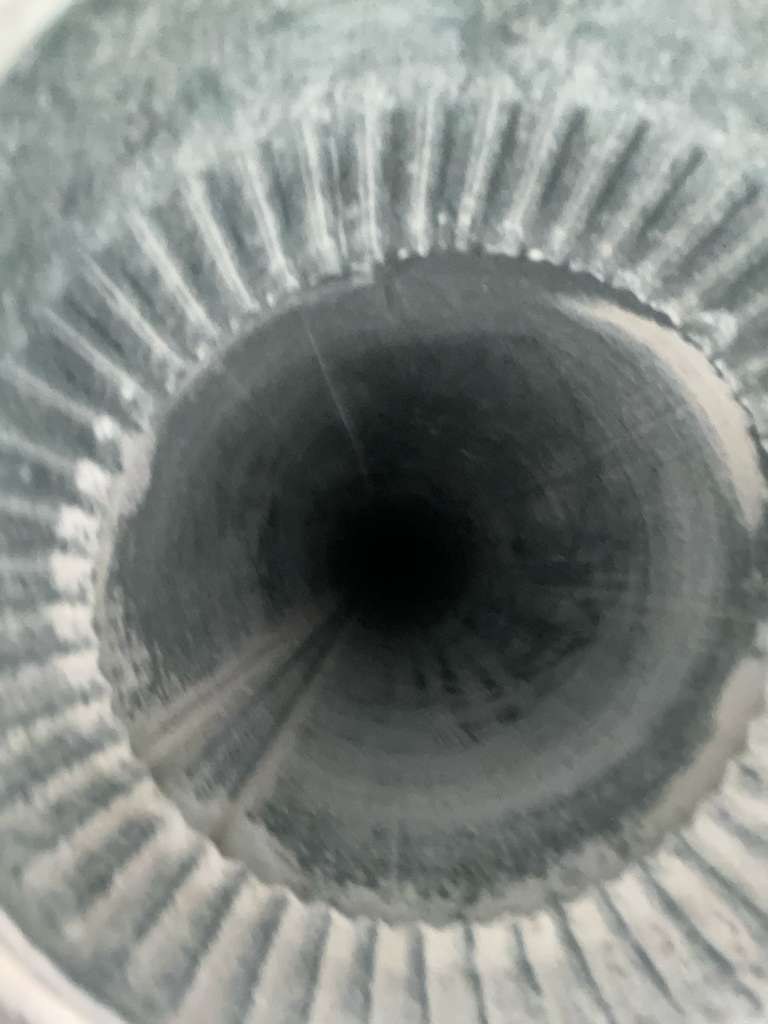
After: same duct cleared end to end, full airflow restored.
The homeowner had noticed the dryer taking two cycles to finish a load but figured it was just an older machine. It wasn’t the machine. It was the vent.
The Signs Most People Miss
A blocked dryer vent doesn’t announce itself dramatically. It just makes everything slightly worse, slowly, until something breaks or catches fire. Here’s what to watch for:
- Clothes are still damp after a full cycle — or dry but it takes two cycles to get there
- The top or front of the dryer feels unusually hot to the touch while running
- The laundry room stays humid after a load finishes
- There’s a faint burning smell during or after a cycle
- The exterior vent flap doesn’t fully open while the dryer is running
- Lint is showing up in places it shouldn’t — around the dryer, on nearby surfaces
Any one of those is worth paying attention to. More than one and it’s time to call someone.
Why Katy Homes Are Particularly Prone to This
A lot of it comes down to how homes are built here. The newer master-planned communities — Cinco Ranch, Cross Creek Ranch, Firethorne, Seven Meadows — tend to have two-story homes with longer, more complex vent runs. The dryer is often on the second floor or in an interior laundry room, which means the vent has to travel farther and make more turns before it exits the building.
Every elbow in the duct creates a spot where lint can collect. Longer runs mean more time for lint to settle before the air velocity drops off. Roof-exit vents, which are common in two-story homes in this area, add even more length and more 90-degree turns.
On top of that, attic temperatures in Katy from May through September are brutal. A lint-choked duct sitting in a 130-degree attic is a very different fire risk than the same duct in a climate-controlled space.
How Often Should You Have the Vent Cleaned
Once a year is the standard recommendation for most households. If you do laundry daily, have a large family, run the dryer more than five or six times a week, or have a long vent run — any of those push it toward every six to nine months.
If you’ve moved into a home and don’t know the service history, clean it regardless of when you moved in. There’s no way to know what the previous owners did or didn’t do, and the cost of a cleaning is a lot lower than the cost of a dryer fire.
What the Cleaning Actually Involves
We pull the dryer out from the wall, disconnect the duct at the back, and run a rotating brush system through the full length of the vent while a high-powered vacuum pulls the debris out from the exterior end. We check the exterior cap to make sure it opens properly and isn’t blocked by vegetation or a bird nest — both of which we find more often than you’d expect.
The whole job on a typical single-family home takes between 45 minutes and an hour and a half, depending on the length and complexity of the vent run. Townhomes with longer routed vents can run closer to two hours.
After we’re done, we show you what came out. There’s never any mystery about whether the job needed doing.
Scheduling a Dryer Vent Cleaning in Katy
We service Katy and the surrounding areas — Cinco Ranch, Cross Creek Ranch, Firethorne, Seven Meadows, Kelliwood, Falcon Ranch, Nottingham Country, and Grand Lakes. Same-week availability most of the time, and we give you a straight quote before anything starts.
Call us at (281) 318-5155 or visit our dryer vent cleaning page to learn more or request a free quote.